
ANZAC Biscuits: an opsimath celebrates an Australian culinary icon

My late mother-in-law’s RAN Anzac Biscuit tin – now in our possession and used appropriately … for storing Anzac biscuits.
First, a definition. The Chief Chef at Google sums it up pretty well: “The Anzac Biscuit is a sweet biscuit, popular in Australia and New Zealand, made using rolled oats, flour, sugar, butter, golden syrup, baking soda, boiling water and desiccated coconut.”
But it is more than that … it is a culinary icon, both in Australia and New Zealand, and it is one I salute every year as the 25th April draws close. If I was writing here the script for a radio play, it would commence:
“Another Anzac Day is upon us, another tray of Anzac Biscuits has been made and consumed, and another “promise-to-self” has been made. This is: “I will in future bake them once a month instead of once a year”.
But you need to be wary of promises like this. There is a danger of over-indulgence, familiarity breeding contempt or even distaste; and there is that business of being careful about what you wish for.
But I can’t see it.
In any well-rounded life is it possible to have too many Anzac Biscuits? I think not. It is a truth universally acknowledged that there is no finer accompaniment to a mug of billy tea than a crisp Anzac Biscuit, especially mid-morning, in the bush, on a chilly autumn day in late April or early May. I have only in my whole life met one person who did not love them.”
But no, this is not a radio play, just another story. Yes, it is about a biscuit, but the story has a personal angle and is based on true-life experience. The fact is, I have reached a point in my culinary evolution where I have moved from being merely a consumer, to being both a consumer and a baker of home-made biscuits. This has led me to working my way through a range of biscuit recipes from the old cookbooks on our kitchen shelf, and to a whole new appreciation of the subtleties of home-baked biscuitry … such as the difference between baking soda and baking powder, or whether to use the “rubbing-in” or the ‘melting” method for incorporating the butter.
Its tricky stuff for a neophyte of the kitchen, I tell you, but I am getting the hang of it.
My urge to bake comes around about once a month or so, and as soon as it bites, I pull out the tattered old CWA Cookbook that once belonged to the Everloving’s grandmother, or the well-thumbed Golden Wattle Cookbook that was my mother’s [Endnote 1]. Or maybe I will refer to something passed on from a friend – for example Irene Batini’s famous Chocolate Chip Cookies (we’ll get to them later).
Trying some new recipe means the Anzac Biscuits are temporarily relegated, overtaken by experiment. The product might be a plate of Afghan Biscuits, Rock Cakes or a slab of Banana Bread. None of these are to be sneezed at. The Banana Bread (I eschew the Woollies packet variety, but make it from scratch with real bananas), is especially good, always eaten with a light coating of salted butter.
But I have to say I have not yet discovered anything to equal the flavour or texture of a snappy Anzac Biscuit. I admit to giving little attention to the aesthetics of the final product – taste and texture are everything.

Underwood’s Anzac Biscuits on the cooling rack and fresh from the oven: not pretty by international baking standards, but golden brown, crisp and “bloody tasty”
There are numerous recipes for Anzac Biscuits, but trial and error has confirmed the one I think is the best. This is set out in her own bold handwriting in the Everloving’s personal recipe book. She can’t remember where she found it, but luckily she read it somewhere many years ago and copied it out; or perhaps it was passed down to her from her mother Jessie, an accomplished cook of the old ‘slaving away over a hot woodstove in a country kitchen’ genre, and the widow of an Anzac. Anyway, the outcome of Ellen’s recipe is unsurpassable, and once I settled on it, I use it invariably:
Ingredients:
1 cup of plain flour (sifted)
1 cup of brown sugar (well crumbled)
1 cup of rolled oats
½ cup desiccated coconut
125 g butter
2 tablespoons Golden Syrup
½ teaspoon of bicarbonate of soda
1 tablespoon of water
Method:
Mix the dry ingredients in a large bowl
Melt butter and golden syrup in a saucepan with the water. When just boiling add the bicarb of soda and stir until it foams
Pour the heated stuff into the dry stuff and mix into a stiff paste
Put little balls of mixture onto baking paper on a tray and bake in the oven at 180 degrees C for 15-20 mins, or until crisp
Place on rack to harden and cool.
Anzac Biscuit afficionados fall into two categories: those that like them snappy and crunchy, and those that like them soft and pliable. I am a crunchy man myself, but I can make the soft ones, simply by halving the amount of Golden Syrup, and I eat them just as enthusiastically. My lovely granddaughter Evie makes a very tasty Anzac biscuit, her preference being the soft variety. I have never been known to refuse one, or indeed three.

Evie arrives for morning tea with her grandparents, bearing freshly baked Anzac Biscuits
What is “Anzac” again?
ANZAC is an acronym for The Australian and New Zealand Army Corps, a title used to distinguish our troops from the British at the appalling battlefield at Gallipoli in World War 1. The men of the Corps became known as “Anzacs” and later the name was applied to all sorts of commemorative things: Anzac Day, Anzac Church Services, Anzac marches, and various food items … including Anzac Biscuits.
Needless to say (or I would not be writing this story) Anzac Biscuits are more than mere biscuits. They have a history, a mythology, a literature. Whole books have been written about them. There is a wide range of variations around the theme, different recipes, each with its champion. The fulsome flavour is accompanied by a cultural milieu, fascinating to the afficionado of culinary history.
The great myth
The story about the invention of the Anzac Biscuit is a romantic one, with a nice touch of Australiana. This is summed up in my 2009 edition of the Country Women’s Cookbook:

Or, according to Google:
Anzac biscuits originated during World War I as a way for women to send a long-lasting, nutritious treat to soldiers fighting overseas. The biscuits, made with oats, flour, sugar, coconut, golden syrup, and butter (or margarine), were chosen for their ability to withstand the long journey and their sustained energy provision. While the exact origin story is debated, the biscuits became a symbol of remembrance and the connection between those on the home front and the troops.
It’s a good story, but it is more than just “debated”. Most culinary historians now believe that while the Anzac Biscuit did evolve during World War 1, they were never sent to the troops – not the Anzac Biscuit that we know and love today, anyway. The romantic story is, sadly, a myth.
The diggers in World War 1 certainly ate biscuits, especially those fighting with the Light Horse in Palestine. As Ion Idriess says in The Desert Column [2], the daily diet of a Light Horseman comprised “steel hard biscuits, black tea and a smoke of the pipe”. But the ‘steel-hard biscuits’ were ‘hard tack’, not Anzac Biscuits (more about Hard Tack in a moment).
It is also true that the womenfolk at home in Australia and in New Zealand made biscuits, including Anzac Biscuits, and Anzac Biscuits were made during the First War (1915-1918). But the reality is that the Anzac Biscuit (as we know it today) was never eaten by the troops fighting in Arabia and Palestine or on the Western Front.
To support this heresy, I turn to my true source, the definitive book on the Anzac Biscuit [3], written by culinary historian Allison Reynolds. A copy of this charming little book graces my kitchen shelf, and I have read it from c to c.

Culinary historian Allison Reynolds with her excellent book
I have never met Allison Reynolds but if I did, I would click my heels, bow, and kiss her hand. She has chosen a good subject to study, and she has done her homework.
Allison does not support the myth that Anzac Biscuits were sent to the Diggers during World War 1, and to back-up her position, she quotes New Zealand food historian Helen Leach:
I have seen no documentary evidence that any items called Anzac Biscuits/Crispies or Rolled Oat Biscuits/Crispies were included in the soldiers’ comfort parcels sent to troops in WW1. In view of the interest in soldiers’ diaries from the Gallipoli campaign and the later campaign on the Western Front any mention of Anzac Biscuits would surely have been noted by now. That items called Anzac Biscuits were actually sent to New Zealand or Australian troops in the period 1915-1918 remains a myth. To my mind, all the food items named after the Anzac troops were purely commemorative.
This view is corroborated by Australian food historian Barbara Santich, who writes about the myth that:
… this is a sentimental story that blends ‘female nurturing instinct with patriotic duty’, it is ‘in the popular imagination’ and ‘it is what we would all like to believe’ … there is no evidence that Australian women packed tins of homemade biscuits and dispatched them off to loved ones in the trenches.
But the subject remains controversial and the debate continues. Allison Reynolds also mentions the article Anzac Biscuits: A Culinary Memorial, by Australian historian Dr Sian Supski. Supski suggests that “it is likely” that a biscuit “resembling an Anzac biscuit” [my emphasis] would have been sent to soldiers. Folk history is acknowledged; in the 1950s there were women who remembered “helping their grandmothers to pack Anzac biscuits into large Golden Syrup tins which were then sent to the troops”. From my review of the literature, I believe that the biscuits referred to here did indeed “resemble” Anzac biscuits but were an earlier version, made with slightly different ingredients.
To understand this, it is necessary to look at some elementary biscuit history.
First, a word about Hard Tack, or ‘Ship’s Biscuits’
When Ion Idriess recalls the “steel-hard” biscuits on which the Light Horsemen were fed during World War 1, he was referring to ‘hard tack’, also known as Ship’s Biscuits or sometimes Army Biscuits. Hard tack is a small, dense, hard-baked biscuit, made from only two ingredients, namely flour and water ... although some more sophisticated hard tack bakers sometimes added a pinch of salt. The biscuits were baked four times, rather than the usual two. Navy cooks, back in sailing ship days, baked them six months in advance of a voyage. At sea they were sometimes made using seawater which would have obviated the need to add salt, but cannot have made them more edible.
The beauty of hard tack, from the Army Quartermaster’s perspective, is that they cost almost nothing, they were easy to pack and store, and they lasted almost for ever. There is a report of two Army Biscuits taken home to England from Gallipoli in 1915 that were found to be still in mint condition in 2014 (and were sold at auction for several hundred dollars). However, the perspective of the soldiers or seamen who subsisted on hard tack, was rather different: they found them tasteless, boring, and they cracked their teeth. Indeed, those with a dental plate could not eat them at all, unless soaked first for some time in hot water or tea. The Light Horsemen referred to them sarcastically as Anzac tiles, considering that they would make excellent roofing material or paving stones.
One trooper described them as “the most durable material used in the war, being completely bullet-proof”. Others wrote messages on them (“Merry Christmas!”) and posted them home.
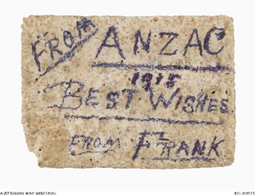
A ‘Christmas Card’ from Gallipoli, written on an 'Anzac tile' (hard tack biscuit) and posted back to Australia, now preserved in the collection of the Australian War Memorial. The writing was done with an indelible pencil.
It is possible that the use of ‘Anzac’ in the name of the hard tack biscuits known as ‘Anzac Tiles’, is one explanation for the notion that Anzac Biscuits (as we know them today) were consumed by the troops in World War 1.
Australian troops in the Second World War were also issued with hard tack. They came wrapped in white paper which could double as cigarette paper and were known to the men of the Second AIF as “dog biscuits”. In his memoir of the fighting along the Kokoda Track [4], Reg Chard recalled: Men cracked their teeth on these biscuits because they were so hard. Some … soaked them in water overnight and then ate the mush the following morning as if it was porridge.
In fact, during the first war, Australian troops did use the Anzac Tiles to make “porridge”.

Diggers at Gallipoli crushing hard tack to make “Anzac Porridge” – photograph from the Australian War Memorial collections
A recipe for what came to be known as ‘Trench Porridge’ by the Australian troops serving on the Western Front has survived:
Trench Porridge: Take I lb of Aussie Tiles … soak overnight in 1 pint of water, shellhole water if procurable … boil for about 20 minutes, add a quarter of a pound of raisins and boil for another 10 minutes. Add milk and sugar to taste [5]
Speaking of hard tack reminds me of a story illustrating that old saying that “one man’s meat is another man’s poison” (or, as Frank Muir memorably paraphrased it “one man’s fish is another man’s poisson”), In their wonderful article on the history of WA’s Two Peoples Bay Nature Reserve [6], Denis Saunders and Graeme Chatfield recount how in the early days Aboriginal people were often employed as messengers by the captains of whaling boats calling in to south coastal bays, including Two Peoples Bay.
The captain of the Charles W. Morgan had on a previous visit to Two Peoples Bay, ‘sent a message to one of the leading men in a town [twenty] miles away’ … by an indigenous messenger, with the promise of a bucket of ship’s biscuits as payment. Only thirty hours later a reply had been returned to Two Peoples Bay. The story continued that whereupon the messenger was paid, he sat down by a stream of fresh water, ate all the biscuits, took a long drink, and then hardly moved for two days.
This is the only account I have ever come across where hard tack biscuits appear to have been relished.
Where did Anzac Biscuits originate?
The precise origin of the “true” Anzac Biscuit remains a mystery and the place where the recipe originated is controversial (with both Australians and New Zealanders claiming the honour). Allison Reynolds tells us that:
Pre-1915, biscuit recipes similar to the Anzac biscuit went by different names, such as rolled oat biscuits, oatmeal biscuits, quick biscuits and surprise biscuits. They share common ingredients - rolled oats, flour, sugar, butter and bicarbonate of soda - but none of them contain golden syrup or coconut.
Nor did these early biscuit versions (unlike hard tack) arrive at the front in prime condition. As historian Bill Gamage noted they were usually stale and rife with weevils after several months at sea and in Army warehouses – but nevertheless the soldiers ate them, if for no other reason than to relieve the monotony of their usual diet … and they were easier to eat than hard tack.
I was pleased to read that the first published use of the term ‘ANZAC’ in a biscuit recipe was in Perth’s Sunday Times newspaper on June 4th, 1916, when a Mrs M Sutherland of Mt Kokeby submitted a recipe to a competition being run by the paper (I was pleased because Kokeby is not far down the road from our place at Gwambygine on the Avon River). Her recipe was for “Anzac Ginger Biscuits” and she was awarded fourth prize:

It is not really an Anzac Biscuit, not as we know it – no mention of rolled oats or coconut and she used treacle rather than Golden Syrup - but the name was now in print and can be considered the forerunner of dozens of subsequently published recipes. Many of the earliest of these so-called Anzac Biscuits contained ingredients we would not use today, for example jam, eggs, dried fruit, even chocolate.
It was not until the mid-1920s that some genius of the kitchen decided to include coconut in the recipe, and this is considered by Australian food historians to be the point at which the definitive Anzac Biscuit evolved. This historic watermark is reflected in the recipe published only five years later in the 1930 CWA cookbook:

My New Zealand friends will not let this pass. Allison Reynolds reminds us that in the St Andrew's Cookery Book, published in New Zealand in 1919, there was a recipe for Anzac Crispies that had all the ingredients of the modern Anzac Biscuit, including the coconut. I bow to this as the published progenitor, even if they didn’t quite get the name right.
I was discussing all this with a friend the other day, and he reminded me that biscuits masquerading as “Anzac Biscuits” can these days be purchased ready-made and packed in cellophane at the supermarket. I tried one once, and my lip still curls with contempt at the memory.
A final word: Rock Cakes and Chocolate Chip Cookies
It would be remiss of me not to conclude this story without mentioning two of my other favourite homemade biscuits.
The Rock Cake is so tasty and so easy to make that I wonder why there is not a tin of them in our kitchen cupboard every day of the week. The tastiness is enhanced by the texture: a cracking crusty outside, and soft cake laced with dried fruit within. My Rock Cakes come out about the size of a large golf ball, one being enough to accompany the morning or afternoon cup of tea, but I can remember wolfing down king size rock cakes, almost the size of a tennis ball, at smoko time in shearing sheds when I was young and hungry.
The recipe I use comes from the CWA Cookbook (I halve the ingredients, as I am only cooking for two):


Underwood’s Rock Cakes, fresh from the oven
My other favourite is the Chocolate Chip Cookie. Like the Anzac Biscuit, its invention was spawned by war, but this time the Second World War, and in America, which is why it is called a ‘cookie’ and not a ‘biscuit’ [7]. It became part of the standard issue in GI rations, and from there its popularity spread far and wide, including Australia.
Also like the Anzac Biscuit there are many variations on the theme. From my experience as a consumer, I hereby acknowledge a true champion of the craft, the maker of the ultimate Chocolate Chip Cookie. This is Irene Batini, wife of my long-time friend and colleague Frank.
Irene writes:
I had been making Chocolate Chip Cookies for many years, but it was not until I employed my grandchildren Rossi and Sienna as ‘tasters’ that I experimented with different combinations, and based on their judgement, hit upon a winner. As with Anzac biscuits, some people prefer crisp and others chewy. Rossi and Sienna prefer chewy, so that’s what we make.

Rossi (aged 3) helping his Nana to make Chocolate Chip cookies, and passing judgement on the result
Here is Irene’s recipe for ‘the perfect’ Chewy Chocolate Chip Cookie.
Ingredients
2 cups white sugar
2 cups brown sugar
A pinch of salt
4 eggs
500gms butter, softened overnight
6 cups of self-raising flour
2 tsp vanilla
1/4 cup milk
4 cups of chocolate chips
Method:
1. Preheat oven to180deg C. Line oven trays with baking paper.
2. In a bowl, cream the butter and sugar into a paste, then add vanilla and eggs and mix.
3. Add the sifted flour and salt.
4. Mix until fully blended; add the milk to achieve a smoothly blended dough. Stir in the
chocolate chips.
5. Place cookies on trays (l use an ice-cream scoop. This was Rossi's idea and it works well) or roll into balls and flatten with a fork.
6. Put cookies in the oven for about 8-10 minutes or until light golden brown. Don't overdo
the cooking, as they'll continue to cook after you remove them from the oven.
7. Take the cookies out of the oven and let them sit on the tray on a wire cooling rack for at
least 15 mins to cool and firm.
8. Store any uneaten cookies in an airtight container - they keep well
This makes approximately 5 dozen medium sized cookies, but the recipe can be halved successfully.
Afterword
Baking biscuits was once a regular affair in our household. Those were the days when the Everloving used daily to make a school lunch for each of our three kids and a crib for me to take out into the bush. A couple of Anzac Biscuits or rock cakes was an excellent accompaniment to a corn beef and pickles sandwich. But the clock ticked, and there came a time when school lunches and cribs were no longer required. The aroma of baking no longer wafted tantalisingly through the house.
But the clock of life continued to tick, and I am now the home baker. Anzac Biscuits are the speciality de la maison, but I also make a tasty fruit cake, excellent damper and one or two other delicacies – my jam tarts are particularly popular with the grand kids. Being an opsimath [8], I was rather proud of my newly-acquired accomplishments in the kitchen … until one day I was telling one of my old forestry mates about it. “The trouble with you, Roger” he said, “is that you have too much time on your hands”.
Once years ago, I said to my lovely granddaughter Poppy (then aged about 6) as I was dishing up an apple pie for dessert “Is that too much pastry for you Poppy?” She looked at her plate and then at me and replied solemnly “Papa, you can never have too much pastry”. Well, my view is you can never have too much time on your hands if you do not have the time to bake and eat Anzac Biscuits, especially around Anzac Day, April 25th every year.
A member of the intelligentsia once had a shot at me over my reverence for Anzac Day, saying I was glorifying war. What nonsense. Anzac Day is about commemorating courage, sacrifice and mateship, and I am proud to do so … and also to get amongst the Anzac Biscuits. More than gastronomic pleasure, they are a culinary tribute, an Australian (and New Zealand) icon.
Endnotes
1. The Golden Wattle Cookbook is notable (at least in my family) for having a Foreword on the nutritional value of food written by Professor Eric Underwood (my father). Although written originally for the 1940s edition of the book, my father’s dietary suggestions are still regarded by dieticians as current. The cookbook has been through 27 editions since it was first published in Perth in 1924.
2. For my review of Idriess’ book, see: https://www.forestleaves.blog/post/an-enduring-classic-ion-idriess-and-the-desert-column
3. The reference is: Reynolds, Allison (2018): ANZAC Biscuits – the power and spirit of an everyday national icon. Wakefield Press, South Australia.
4. The Digger of Kokoda by Daniel Lane (2022) Macmillan Australia. The Kokoda campaign also saw the emergence of what the troops called “the Biscuit Bomber” – a twin-engined Dakota DC3 aircraft used for dropping supplies to troops in remote areas.
5. World War 1 diggers had an ironic sense of humour. In addition to ‘Anzac Tiles’ and ‘Trench Porridge’ there was an infamous dish they called ‘Anzac Stew’. This was described as “an urn of hot water with a bacon rind in it”.
6. The reference is: Chatfield, G. R and Saunders, D. A. (2024). History and establishment of Two Peoples Bay Nature Reserve. Pacific Conservation Biology 30, PC24004. It can be found on the internet at https://doi.org/10.1071/PC24004
7. What Australians call biscuits the Americans describe as cookies. The American biscuit is what we call a scone. I recall a sorry occasion about 20 years ago when one of the Australian supermarkets started branding their Anzac Biscuits as “Anzac Cookies”. The outcry from customers was so antagonistic that they had immediately to re-brand them. (It is interesting to speculate whether the same thing would occur today, our modern society being so penetrated by Americanisms).
8. An ‘opsimath’ is one who learns something only late in life. It is a term I learned (late in life) from Alan Bennett’s delightful book The Uncommon Reader, and I am pleased to be one.


Another beauty Roger, and yes, few things are better than an Anzac or three and a hot cup of tea!