
Aromatherapy in the bush: reflections on fragrance and memory
Updated: Sep 3

A 1920s song sheet, reminding me of one of my favourite bush aromas.
It came as no surprise to me the other day, when I read that scientists have confirmed that of all human senses, the sense of smell is most closely linked to the memory banks in the mind.
I know what they mean.
I not only enjoy the distinctive aromas of the Australian bush (and others) but have found many times in many places that a whiff of something in the air will instantly transport me back to some event in my distant past, the aroma surfacing old memories, often of things I had forgotten I had forgotten, and of long-lost friends and emotions.
The great Australian bush poet Banjo Patterson understood the links between memory and aroma. In his lovely poem The Wind’s Message he wrote:
… there came a whisper down the Bland between the dawn and dark,
Above the tossing of the pines, above the river’s flow;
It stirred the boughs of giant gums, and stalwart ironbark;
It drifted where the wild ducks played amid the swamps below;
It brought a breath of mountain air from off the hills of pine,
A scent of eucalyptus trees in honey-laden bloom;
And drifting, drifting far away along the southern line
It caught from leaf and grass and fern a subtle strange perfume …
He went on to tell how city folk who had once lived in the bush, would catch the scent of this breeze, the “wind’s message”, and it would bring memories of voices silent now, and songs of long ago.
My best-loved aromatic memories are also mostly of the bush. The Australian bush has a unique fragrance – it varies, depending on where you are, but there seems to be some resonant undercurrent that is common to many different landscapes and ecosystems. Travelers returning from overseas on sailing ships in the 19th century could detect it in the air even before land was sighted – an amalgam of eucalyptus oil, bushfire smoke, dry grass and wattle bloom. Perhaps the most universal and best-loved of all is the smell of rain on hot, parched earth – it is so distinctive it even has its own name: “petrichor”.
Other aromas trigger other memories going back to times before I knew the bush. The smell of chalk and floor wax, for instance, takes me back to my primary school days at Nedlands State School in the early 1950s, and I instinctively duck, expecting a well-thrown piece of chalk from the feared Mr. Thorpe, or rasping sarcasm from the dreaded Miss Arcus. The tang of coal smoke conjures an image in my mind of the steam locomotive beating up the Karrakatta Bank to the railway station in Claremont, thence to take my mother and me on an expedition to Fremantle to visit her sister.
Then there is the smell of freshly baked bread. This is always enough for me to become again a stripling cycling down to the local bakery to pick up fresh bread for Mum to make the school lunches on Monday mornings. I loved that old-fashioned bakery on Waratah Avenue, with the warmth and heavy smell of hot bread from the huge, black wood-fired ovens. Heading home I would nearly always cycle around past the yards where the tired old horses would be standing, heads drooping in expectation of another day of boredom on their rounds of the suburb. This was just after the war, petrol was rationed, and both the baker and the milko delivered by horse and cart. Those horse yards at our local bakery also had their own dungy aroma – pungent and earthy – and it also lives on within the byways of my memory.
By the way:
I once had an interesting experience with the baker’s horse and cart. When I was about 8 or 9 years old, and during the summer holidays, I sometimes used to go for a ride with the baker on his cart, doing a few circuits around the suburban blocks near our place. The “baker” (as we called him, although in retrospect I realise he was just the delivery man) was a swarthy, cheerful young man, and he would welcome me up onto the high wooden seat of his two-wheeled bread cart and let me hold the reins and slap them gently on the horse’s rump to signify “go” or “stop” and to indicate turns. All of this was redundant actually, as the horse knew the round and the stops to perfection and could have done it blindfold. One day when we pulled up outside one of the mansions on Victoria Avenue, the baker said, “You can deliver here today if you like, son”. I was thrilled and marched up to the front door full of self-importance, the loaf in a wicker basket over my arm. Before I could knock the door sprung open and there stood the lady of the house with open arms. She was naked.
Not knowing what was expected of me, I handed over the bread and retreated hastily to the cart. The baker roared with laughter at the sight of my face. I realised later that this young man had a tougher job than I had imagined. I cannot remember his name, but it might have been Pedro.
I recently read a wonderful account of the smell/memory linkage. In her outstanding book on the language of honeybees [2], Tania Munz recounts a significant moment in the life and career of Arthur Hasler, who carried out pioneering research into the ability of salmon to find their way back to their native spawning grounds. Returning to the USA from Germany after the War, Hasler took his family on a trip to Utah, where he had grown up. One day they set out on a hike up Mount Timpanogos. As they came to an outcropping of the mountain, Hasler was struck by a sudden wave of recognition. A distinctive smell— from the flowers, earth, and air—washed over him. And then it hit him — it was the smell of home. Hasler later recollected:
As I hiked along a mountain trail in the Wasatch Range of the Rocky Mountains where I grew up, my reflections about the migratory behavior of salmon were soon interrupted by wonderful scents that I had not smelled since I was a boy. Climbing up toward the Alpine zone on the eastern slope of Mt. Timpanogos, I had approached a waterfall which was completely obstructed from view by a cliff; yet, when a cool breeze bearing the fragrance of mosses and columbine swept around the rocky abutment, the details of this waterfall and its setting on the face of the mountain suddenly leapt into my mind’s eye. In fact, so impressive was this odor that it evoked a flood of memories of boyhood chums and deeds long since vanished from conscious memory.
It was at that moment that it occurred to Hasler that the salmon’s homing ability must somehow relate to memory of a native smell. Over the following months and years, he was able to prove this hypothesis experimentally, and it would endure as a cornerstone of biological research. Again and again scientists have been able to link the sense of smell to data in the memory banks of the brain.
The sense of smell is not just a wonderful thing, probably more acute than any of the other senses, even without its links to memory, but one that evokes so many pleasures. One of my favourite writers, the farmer, historian and poet Eric Rolls, has written about this [Endnote 1]:
It is good to eat in big country kitchens. Guests can talk and drink and smell the food cooking. A lifted lid releases excitement and expectancy. No matter how often one smells them, onion and garlic turning golden in oil, smell good. One tests the air to see what meat will be browned with them. The kitchen influences the house. It draws one with webs of odours. One walks towards it down corridors of smells.
Strangely the sense of smell and the other senses do not always align. For example, I love the smell of freshly ground coffee, but the taste never quite lives up to its promise. I have also to admit that my sense of smell is deficient when it comes to detecting the various aromas stated (on the label on the bottle) to reside in an expensive wine (“A faint suggestion of rhubarb and blackberry, with lingering overtones of bluebells in springtime” etc etc). When I read this wine-maker tosh, I am always reminded of how James Thurber once sent it up in a New Yorker cartoon: the pretentious host is about to pour the wine at a dinner party, and he boasts:

I also find honey tricky. An old Forest Ranger who worked for me once, Sonny Cave, was an amateur apiarist (and a good one). Sonny used to say he could tell me what species of tree a pot of honey came from by the aroma. Under his tutelage, I came to be able to distinguish wandoo honey from (say) marri honey by taste, but I could never do it by smell. I asked my colleague Ian Kealley about this, as his father was a famous apiarist and Ian grew up amongst bees and honey.
“Old Sonny might have been pulling your leg [Ian said]. While some of the eastern states’ honeys like Tasmanian Leatherwood or NSW Manuka have strong, distinctive aromas, most of the WA forest honeys are light and almost aroma-free”.
Perhaps I am just parochial, but I prefer the lighter WA forest honey to the darker and stronger honey from the east, and I can certainly smell something when I put my nose into the pot or walk past the hive in our back yard.
And yet, and yet. Who can forget the scene in that wonderful book A Gentleman in Moscow where the Count (our hero), worn down by the years of his incarceration by the Bolsheviks in the Hotel Metropole in Moscow, climbs up to the hotel roof, intending to leap to his death, putting an end to it all. But at the last moment he encounters the old hotel handyman with his beehives up on the roof of the great hotel, and they share memories of their youth over hunks of black bread slathered with fresh honey, the aroma of which captivates the Count. And later, when the bees return from a foraging expedition they bring with them the perfume of the apple orchards on the Count’s long-lost estates, lifting his spirits and his will to live. It is a scene that will long live in my memory. This is especially so when I happen upon apple trees in full bloom and are drenched in their perfume [3].
Essences of love
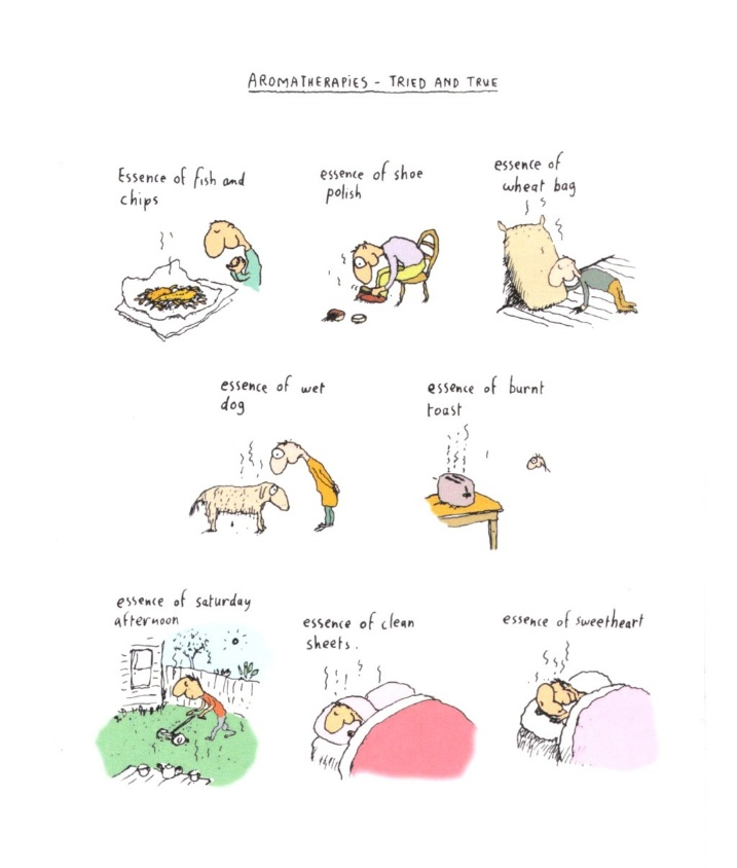
The cartoonist Michael Leunig has dealt succinctly with this issue, detailing his favourite “tried and true” aromas, all of which I also love (especially the last):
I also love the beautiful poem The Lemon Trees by the Italian poet Eugeo Montale. Leaving behind “the noisy cities where the sky is only patches of blue, high up, between the cornices”, Montale dips into an orchard, with groves of lemon trees, where:
… more clearly now, you hear the whisper
of genial branches in that air barely astir,
the sense of that smell
inseparable from earth,that rains its restless sweetness in the heart.
Here, by some miracle, the war
of conflicted passions is stilled,
here even we the poor share the riches of the world—
the smell of the lemon trees ...
On our little property at Gwambygine the biting frosts of winter and baking 40-degree days of summer make successful lemon cultivation difficult, but we have a lovely grove of orange trees (Navels and Valencias). The aroma that surrounds them when they are in bloom is sweet and tantalizing, always redolent with the promise of succulent oranges to come. Then the fruit does its own aromatic job, with the tart citrusy smell left under my fingernails after I have peeled one.
Speaking of lemon scent …
Can there be a more wonderfully aromatic tree than the Lemon-scented Gum (Eucalyptus citriodora)? On a humid day you can walk beneath one of these lovely trees, or better still a grove of them, and the whole atmosphere is palpable with the sweet-tart smell of citrus. And on a hot summer day, the powerful essence floats up from the dry leaves crunched below your boots.

A fine Lemon-scented gum in a city park in Canberra
Regrettably I only know the Lemon-scented Gum as an urban tree, never having worked in or visited the forests where it naturally grows in Queensland, or the plantations that have been established in East Africa and South America. It is a tree to admire, but also to be wary of in the home garden or urban park. Even in the Mediterranean climate of Perth, it grows into an enormous tree, and the limbs become brittle with age, with a tendency to drop heavily onto precious things below.
One of my favourite memories of this tree was the time I visited a farm way out in the WA wheatbelt east of York. As I drove in to the homestead, I passed an avenue of stunted eucalypts with light green leaves and white bark; they were surviving, but well out of their comfort zone. “By the way” the lady of the house (they were recent escapees from suburbia) said to me later as I was leaving, “I don’t suppose you know what sort of trees are those ones along the drive, do you?” I replied “Come with me” and we walked over and I plucked a handful of leaves from a low branch. Crushing them in my fist, I said “Smell that”. Yes, they were Lemon-scented Gums, and the two old-timers were astonished and entranced by the aroma. This was their first exposure to the classic Lemon-scented Gum aroma operating at full throttle - one of nature’s most glorious gifts.
The downside
But not all aromas have happy associations. I particularly dislike that distinctive ‘hospital smell’ that pervades every medical clinic and hospital I have ever been in. It always brings back memories of the ward at St John of God’s Hospital, Subiaco, where I spent some months after an accident when I had just turned 12. I suffered a severe injury to my left eye, and for some reason, both eyes were bandaged, and I was confined to bed and darkness. The only thing that kept me sane was the soft, lilting voices of the young Irish nuns, their affectionate, gentle ministrations and their clean, soapy smell – a lovely smell, but not able to overcome the power of the disinfectant with which the ward was swabbed out daily. I knew all the nuns by their voices and came to love them. There was one exception. The Boss Nun was a fierce old martinet who terrified me, just as she terrified the other nuns. She caught me once putting my fingers up under the bandages to scratch an itch, and bending over, said in a terrible voice that if she ever saw me doing that again, she would strap my arms to the bed. I have always been slightly claustrophobic, and the idea of being blindfolded and strapped down was truly terrifying.

Nursing nuns of the Order of St John, outside St John of God’s Hospital in Subiaco, back in the 1950s
Eventually my bandaging was reduced to cover only the injured eye, and I was allowed visitors other than family. My two best friends were the first. Phil Ledger was dressed in his Sunday best and was nervous and anxious, so unlike his normal ebullient character, and neither of us could manage our usual banter. Rob Jowett also turned up, having bicycled about 25 km all the way from Circe Circle, dressed in the more traditional schoolboy outfit of the day, khaki shorts, short-sleeved shirt and sandals. He sat wordless by my bed for an hour, the tears streaming down his face. I am not sure who was the most miserable, Rob or me. Years later, Phil explained: the word had passed around school that I was dying and probably would not see out the week.
The ‘hospital smell’ also reminds me of the death of my father. The sharp bite of this memory has faded over the years but is still one of sadness and loss. Hardly a day goes by that something does not come up that I would like to discuss with him.
Dad did not survive his final challenge in Royal Perth Hospital, but I got better. I ended up with only about 20% of sight in my left eye, but I was able to resume a full and active life. I was never the cricketer or tennis player I would have liked to have been, but I played a lot of football, including under-age suburban and inter-school comps, then later at university and in the bush. The years of bush footy have stored a particularly powerful and evocative aroma in my memory - that of embrocation, the stuff they rub on aging footballers to loosen up their muscles before a game. I never used it, but it was ladled onto the legs of many of my team-mates in my days playing for Pemberton against the arch-rivals at Deanmill, Jardee, and Manjimup. These games were fiercely competitive, and when we played on our home ground, the entire town would turn out in support. Of all the football I played, this was the toughest and roughest. My team-mates and opponents worked in sawmills, drove bulldozers, felled karri trees or dug potatoes for a living and were big, powerful and sometimes vengeful, there being some serious rivalries between the neighbouring towns. I had played in the ACT competition when I was a forestry student in Canberra, but the games there were gentlemanly encounters compared with a Pemberton-Deanmill match.
In the bush
Many of my favourite aromas take me back to my years working as a forester in the southwest. What a joy it is when something in the air unexpectedly twitches my nostrils, and my mind wheels back across the years to a notable adventure, somewhere in the southern bush.

The youthful forester in the karri forest in 1964. The bush was always wet in those days, and I found that the driest and warmest place to eat lunch was on the bonnet of my jeep (photo by John Evans).
These days I live mostly in the city or out on the Avon River near York. But I am lucky because my interests and friends still occasionally bring me back to the karri country where I worked for so many years. The drive to Pemberton, Northcliffe or Walpole takes me down the Southwest Highway to a point where, a few miles south of Manjimup, the road swings away to the southeast, just beyond the old mill town of Jardee … and all of a sudden, I can smell the karri wattle. As my nostrils fill with that distinctive and pungent aroma, a dozen memories come flooding back. Like the night we fought the fire on Heartbreak Trail.
The fire on Heartbreak Trail
It was December 1960, I had just finished the second year of my university studies, and I found myself working as a firefighter at Pemberton, in Ted Loud’s gang. Ted was an ex-World War 2 commando, an experienced bushman and forestry overseer, a renowned former footballer and fist-fighter, and considered to be the toughest man in the karri country.
Ted was also known to have an unreasoning hatred of university students, especially those assigned to his gang for the summer months. I’m not too sure what the Japanese thought of him when he was a commando operating behind their lines in Timor in l943, but he scared the living daylights out of me.
Within a week or so of my joining Ted’s gang there came a day when a dry lightning storm ran across the karri country and numerous bushfires started in the forest. Our gang spent the afternoon dealing with a small fire down along the East Brook not far from Gloucester Tree fire lookout. The fire was burning quietly in light fuels adjacent to the logging railway whose steam locomotive was responsible for the light fuels adjacent to the line, and it was soon dealt with. Just as we were about to pack up and return to HQ another fire report came in and we were dispatched again. This fire was in the Warren National Park near where the Heartbreak Trail crosses the river on a rocky bar. The bush here hadn’t been burnt for years, and the scrub and litter were so dense you could hardly walk through it. Above towered the mighty karri trees, nearly 80 metres high.

Towering karri forest in the Warren National Park
It was early evening, and almost dark when we reached the fire, and the scene was a fantastic one: a steady front of flames a metre or two in height was eating its way up the steep hillside, lighting from below the giant trees and swaying scrub. The fire was slow-moving but very hot, as it consumed tonnes of dry leaves, bark and litter on the forest floor.
In the days before the great Crowea Fire of March 1961 (this followed a month or two after the events described here [4]) bulldozers were not readily available for firefighting, and firelines were still being cut by hand. This meant constructing an earth containment line along the edge of the fire with shovels. The firefighters would work from the tail or upwind end of the fire along its flanks, where the intensity of the flames was lowest, eventually (if possible) reaching the headfire, and pinching it in. ‘Spadebreaking’, as this operation was called, was usually only done at night, under relatively windless conditions or in light fuel. An intense karri fire, with the flames reaching into the tree crowns, or an actual crown fire, was impossible to control, especially by men armed only with shovels.
We worked all night at that fire, constructing and holding about two thousand metres of hand-dug fireline on the hillsides up from the Heartbreak crossing. When the sun came up, and the first slanting beams reached into the Warren River valley, it drew from the unburnt karri wattle outside our break a powerful and pungent aroma.
It is a smell which will stay with me as long as I live … and my memory not only conjures up the aroma of sweating wattle and karri woodsmoke, but also the sight of the forest through which the fire had run. In the first light of dawn, it was still smoking gently, and there was a patina of white ash over everything. It had been a relatively mild fire, and the tree crowns above were untouched, still green and swaying gently in the breeze, as if to say, “Ho hum, just another fire”.

The morning after a mild-intensity fire in the karri forest (photo by John Evans)
Buying back the farm
In 1964, by now a forester, I was posted to the small forestry and timber-milling town of Northcliffe. When winter set in I started on an interesting and rewarding assignment: I was “buying back the farm.”
The agricultural districts at Northcliffe had been settled in the l920s as part of the Group Settlement scheme but mostly had not succeeded. Thousands of hectares of prime forest were ringbarked and burnt, but few successful farms resulted and there was great hardship for the original “groupies”. Living conditions were primitive, and the economic situation perilous: the settlers simply could not earn enough through farming to repay the debts incurred in the development of the farms.

The Bashford family - group settlers at Northcliffe in 1925 outside their first home.
Then, when the Great Depression set in during the early l930s, the situation for the groupies became desperate, and many families simply walked off, their farms abandoned. Ownership of the abandoned blocks reverted to the State-owned Agricultural Bank, and the properties soon became derelict. The forest began to reclaim its sovereignty.
The farms abandoned in the 1930s were still nominally “on the market” when I arrived on the scene in the winter of 1964, and they could be bought from the Agricultural Bank for a few shillings an acre. By this time a new karri forest was coming away amongst the white ringbarked stags. These new forests were thirty or forty years old when I first encountered them, and they looked magnificent. The Forests Department saw an opportunity and decided to start buying.

Regrowth karri forest at Northcliffe, about 40-years old
My job was to locate, survey and then prepare the papers for the purchase of the best forests on the old Group Settlement blocks held by the Agricultural Bank.
I started with a general reconnaissance by jeep, accompanying the famous Assistant Forester at Northcliffe, Jim Loverock. The road reconnaissance was followed by a detailed examination of aerial photos, old topographic maps and the new API (aerial photographic interpretation) maps for the karri forest region, which were being prepared by my friend Jim Williamson at Manjimup at that time. This information enabled me to prepare a map showing the location of all the best regrowth forests on the old group blocks. It then became a matter of detailed surveys on the ground … each area had to be walked, and the forest assessed and measured. Back in Jim’s office (where he usually had a nice blaze going in the fireplace) I would plot up my survey data and prepare a report for each location, and a recommendation for purchase. This would be posted to Head Office, and if approved, an offer made to the Agricultural Bank. If all went well, a former karri forest, then a dairy farm, and now a karri forest again, would become private property owned by the Conservator of Forests, making it equivalent to State Forest.
Winter in the karri country of the deep south was cold and wet, and the assessment work in the regrowth forests of the old group farms meant spending most of the day in wet clothes or trying to fill in a soggy field book in the jeep when the downpour became too intense.
But there were many compensations, and one has endured in my memory. Driving out from Northcliffe one morning to reconnoiter a new survey, I passed through a dense ti-tree swamp which embraced the narrow track on both sides. Suddenly my jeep filled with the overpowering perfume of boronia blossom. I stopped to explore and found that the swamp was a mass of boronia wildflowers, all in bloom. It was a still, humid spring morning and a cloud of sweet perfume hung in the air. It was so dense you could almost touch it, and so beautiful as almost to be intoxicating. I think it was 20 minutes or so before I could drive on.
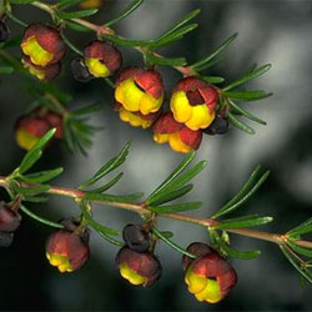
Blossom of brown boronia (Boronia megastima), the sweetest smelling of all Western Australian wildflowers.
There are no boronia swamps where I live these days, but occasionally I’ll buy a bunch for Everloving from a flower seller. Every time, there is a moment after the first sniff, when in my mind I am back at Northcliffe again, working in the drenching rain, and buying back the karri forest.
Burning bush
Of many occasions when a particular aroma has evoked memories for me, probably the most sentimental occurred during the time I was living in the United States in the mid-1960s.
I was studying at the University of Washington at Seattle, and for the first few months after my arrival, I lived a rather miserable life in a student “dorm”. This was a grim eight-story concrete building … but there were compensations here as well, such as my grand Canadian roommate John Harker, with whom I shared each night a small (and illegal) tipple before dinner, and also the in-house amateur dramatic society, where I met some lovely and unforgettable young people.
Also, if the weather permitted, I used to go for a daily run, and my favourite place was the University Arboretum which was close to the dorm and comprised about twenty hectares of lawns, superb groves of American and European trees and curving paths on which to jog. It was a place a forester could return to over and again and I often came across something of beauty to admire, or of interest to explore. It was autumn, and the deciduous trees were in their full glory, the beauty of which I had never appreciated before.

The University arboretum in Seattle in “fall” with the deciduous trees in glorious colour
One day in a far corner of the Arboretum I came across a straggling eucalyptus tree. Unlike in California where they were omnipresent, eucalypt trees were almost unknown in Washington at that time. It was the first I had seen since leaving Australia.
As far as I could tell it was Snow Gum. I gathered a few leaves from beneath it and took them home, crushing and breaking them to pick up that pungent smell of eucalyptus oil. Then for some reason I idly applied a lighted match to one of the leaves. Instantly the smell of burning bush filled the air, and a longing for home and for the Australian bush almost overwhelmed me. Some city people in Australia these days make a huge fuss when a few whiffs of bushfire smoke drift into the suburbs, especially if the source is a prescribed burn, part of the bushfire mitigation program. I am the opposite. I love the smell of bushfire smoke. It is the quintessential smell of Australia, the great tugger of heartstrings to exiles, the great welcomer to home-comers. I have never had any trouble in understanding why the Australian Aborigines regarded bushfire and woodsmoke with such reverence.
Eric Rolls has written a poem called Gum Leaves Burning that I always find evocative.
Twisted roots of box, a hollow ironbark knot,
Burn in pastel oranges and blues, brown, green,
mauve and black.
The chimney draws as chimneys aught.
Nervous flames record each light
The wood grew by. A spectrum of two hundred years
Warms us this one winter’s night.
The smell hangs lightly in the room
Of handfuls of dried gum leaves thrown among the kindling.
A certain testimony to an Australian home.
Those leaves give permanence to flame.
As mountains crumbled, as parades of people
withered by the hearth,
First fire, last fire, they smelled the same.
Since reading this poem it has been my habit to rake up a handfull of dry leaves under the Illyarrie (Eucalyptus erythrocorys) by our front gate and pop them on the freshly lit lounge room fire. The aroma never fails to delight.
Memories of woodsmoke
Over the years, I have spent a lot of time fighting bushfires, running prescribed burns, yarning around campfires in the evening, or sitting in the lounge room on a winter evening, feet up, and staring into the flames of the open fire, reflecting on ‘the inevitability of the absolute’ [5]. I can recognise the distinctive scent of many different types of bushland woodsmoke. The smoke from fires in wandoo and karri forest give off an entirely different aroma. A burning grass tree has a warm and pungent smell. Coastal peppermint, mulga, a ti-tree swamp, pine, mallett, spinifex ... the smoke from each has a distinctive aroma and can take me instantly down a network of memory lanes, mostly to happy, or at least to exciting times. The most beautiful smelling woodsmoke of them all comes from the native cypress pine (Callitris roei, I think) which grows in the southern rangelands. Sometimes I used to bring a lump of pine firewood home to Perth to burn in the hearth on a winter evening. The whole house would fill with glorious perfume. I realised once, walking my dog after dark, that you could smell it all around the nearby streets, and I wondered if any old bushman had caught a whiff and been transported back to his days outback as a stockman or shearer. To me, the odiferous cypress pine smoke is a unique aromatherapy; I could never smell it without being conveyed back inside my brain to the camp under the gimlets at Mt Gibson Station, where the Everloving and I and our kids, spent such good times.
The poet Shelley knew about aromas and memory. He wrote:
… Music, when soft voices die,
Vibrates in memory.
Odours, when sweet violets sicken,
Live within the sense they quicken …
Indeed, violets have a delicate, subtle perfume, as do so many of the blooms in the traditional English scented garden. I have many favourite garden fragrances, especially jonquils and jasmine, and of course nothing beats the perfume of an old-fashioned rose [6].
Aromatherapy
Technically, the term “aromatherapy” is used to describe the inhalation of certain essential oils distilled from plants. The supporters of this form of alternative medicine claim that it cures a wide range of illnesses and complaints. But the hard evidence of its therapeutic efficacy is uncertain, and it is looked down upon by most modern western doctors.
But there is another meaning to the term. Like most foresters, I had a rewarding and exciting life in the bush. Even better, all these years later, the sense of smell provides a trigger to the data banks of my mind, allowing good times to be re-lived, memories vibrated, senses quickened, and that frisson of pleasure that produces a “restless sweetness in the heart” and can lift a jaded spirit.
This aromatherapy works for me.
Endnotes
1. From: Celebration of the Senses (1984) by Eric Rolls, Penguin Books, Australia
2. Munz, Tania (2016): The Dancing Bees. University of Chicago Press, USA
3. A Gentleman in Moscow by Amor Towles (2016) Windmill Books, London. Possibly the most enjoyable novel I have ever read.
4. The story of the Crowea Fire, the first time I saw a crown fire in the karri forest, is told earlier in these chronicles. See: https://www.forestleaves.blog/post/the-1961-crowea-fire
5. This was a favourite saying of my father, and I knew it and could quote it (with a quiet philosophical expression on my face) well before I understood it. Dad was himself quoted it from one or other of his favourite authors, but I have no idea of the source.
6. The loss of the fragrance that has resulted from breeding roses for appearance rather than scent is one of the saddest outcomes of modern horticulture. Few things disappoint more than stooping to sniff at the bloom on a beautiful rose bush and then smelling … nothing. OK it was an unintended consequence of plant breeding, but it was one that should have been strangled at birth.


Ah Roger, you are wasted on the vicissitudes of life. Would that the opponents of your wise bush and forest management replace their harshness with your love! While I am a non-seasoned and recent acquaintance of yours, I am so almighty proud to call you 'friend'.