
Gimlet: the tree with a coat of many colours
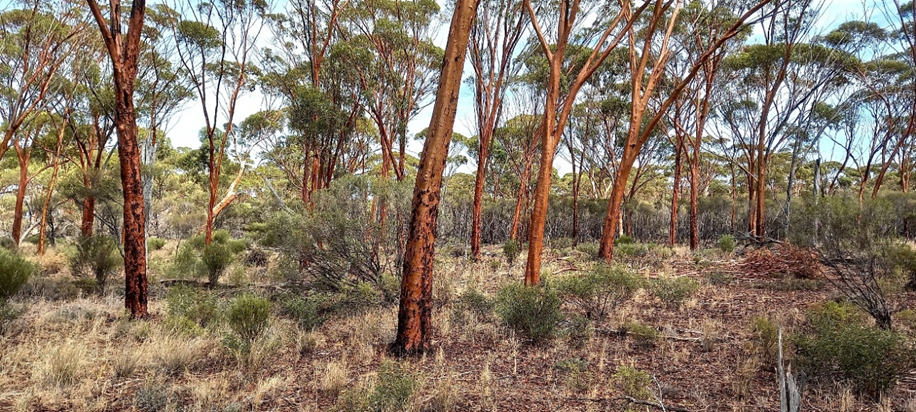
Giimlet trees in their autumn colours, at Yeerakine Rock (photo by Ian Keally)
Back when I was a lad, in the years just after World War II, I was a devotee of Captain Lorrington King, known as “Gimlet”, the hero of a series of boys' adventure stories. Gimlet was a clever and brave British army commando who made life unpleasant for the Nazis. Accompanied by his two off-siders, one a Cockney former London cop and the other a cunning French-Canadian bear-trapper with a penchant for silencing sentries with bow and arrow, Gimlet would cross the Channel at night in a canoe, and cause havoc amongst the Wehrmacht.
Captain King was nicknamed Gimlet because of his piercing blue eyes, which were said to "bore through you". My father explained. A gimlet, he said, was a corkscrew-like implement used to bore holes in leather. My father knew about this because his father had been a saddle and harness-maker, handy with the gimlet.
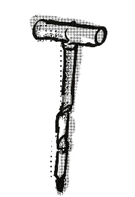
A harness and saddle-maker’s gimlet
It was only years later, when I first began to explore the beautiful woodlands of inland Western Australia that I discovered the Western Australian tree called ‘gimlet’ (with its lovely botanical name, Eucalyptus salubris). It is one of the world’s most beautiful trees.
Moreover, it is a tree with a coat of many colours. It is a chameleon, the colours of the bark changing with the seasons through the year.
Every year in the heat of summer, the old bark is shed in strips and ribbons, revealing the new bark beneath. This is initially yellow, but soon turns a lovely, shiny olive-green, almost the same colour as the foliage.

Mid-summer: bark shedding begins, giving the first glimpses of the new green bark beneath.

Early autumn: the new olive-green bark (photo by Jack Bradshaw)
By late autumn the bark has weathered to a deep bronze. When the gimlet woodlands are in their “bronze phase” as I call it, you would think that they had been invaded by seven maids for seven years polishing and burnishing the trunks of the trees with Brasso.

Gimlet in its bronze livery (photo by Malcolm French)
Gimlet trees were once widespread in what is today the croplands of the Western Australian wheatbelt and they are still found in reserves and on roadsides, where they grow on heavier clay soils, often in association with salmon gum (thus uniquely combining two of the world’s most beautiful trees in the one spot). One of the finest stands of gimlet I know is in the Chiddacooping Nature Reserve north of Westonia. This reserve is notable as the place where famous forester George Brockway collected seed of the variant of Eucalyptus caesia, now the ubiquitous and beautiful specimen tree known as ‘Silver Princess’. It is also one of the few places where I have seen gimlet growing in extensive pure stands.
Gimlet is still widespread throughout the inland woodlands and is seen at its best north of Kalgoorlie on the road to Kanowna, especially in the late afternoon in April; this is an excursion that should be on the bucket-list of every tree-lover.
Silvics
Gimlet is a small tree, rarely more than 15m in height and often multi-stemmed. The long, slim trunks tend to be fluted or corkscrewed. This explains the name given to it by pioneer bushmen, all of whom would have been horsemen and familiar with the tools of saddle and harness repair, such as gimlets.

The trunks of two of my gimlets at Gwambygine, showing the fluting and corkscrews
I recently read a reference to this in a story by famous Western Australian writer Katherine Suzanna Pritchard. She observed “thickets of gimlet, dark-leafed, with a natural screw down their slim, bronze trunks”, hitting the nail on the head.
Gimlet is a long-lived tree, capable of reaching several hundred years in age, provided it does not suffer a bushfire. But even then, the species is well-equipped for survival. Unlike most eucalypts, gimlet does not have a lignotuber (or "mallee root") from which new shoots come away after the tree has been burnt. But if the tree finds itself under stress, or if the crown is damaged by strong winds, it is capable of producing new shoots from the trunk. These have a beauty all of their own.

New shoots at the base of a gimlet on my property at Gwambygine. The tops of the tree had been broken by high winds in a summer thunderstorm.
Gimlet is extremely fire-tender. Even a mild, trickling fire will kill the mature tree, the sapwood and cambium being poorly protected by bark that is so thin you can scratch it off with a fingernail. However, gimlet will coppice (sucker) from the stump of a felled tree, and every year the mature trees carry a mass of seed. This is a fact well known to the ants on my property, where I have planted dozens of gimlets. The ants enjoy an annual feast of gimlet seed when it trickles down on a hot summer's day. Some ripe seed is nearly always present in the crown of the tree, in fact there are usually two crops of seed on the tree at any one time, this year’s and last year’s.
But while fire kills the mature trees it also ensures regeneration. The fire prepares a welcoming seedbed of ash on the woodland floor, temporarily discourages the ants, and provides the heat to open the woody seed capsules up in the tree crown. Mother Nature times all this to perfection, so the seed is released onto the ashbed only after the ground has cooled. Here it germinates en masse after the first winter rains.
I have seen gimlet seedlings coming away like a wheatfield after fire. This was no doubt well known to Aborigines who harvested saplings from an area burnt a year or two previously to make spears, with fire-hardened tips.
Superb timber
Gimlet timber is heavy, strong and straight-grained. It has special acoustic properties and is said to be as good as European spruce for making the head-joints (or “mouthpieces”) for wooden flutes.

Flute headjoint, made from gimlet, with gimlet tree trunk as background. (Photo by Ian Kealley)
It also has a special beauty when made into furniture, although there is a drawback, the resulting pieces being extremely heavy. Once in position, a cabinet made of gimlet is in place for the duration.
Gimlet timber is incredibly hard - you can barely dent a slab of it, even when you strike it savagely with a ball-peen hammer. But it is not durable in the ground; a termite will travel miles to dine on a gimlet fence post. The early shepherds and settlers instead used it for hut rafters, sheep hurdles and gate rails - anywhere a long, strong, slim piece of timber was needed and where the termites could not get at it. I have used it for a prop for a wisteria creeper, but I first ensured it was standing on bricks where it is relatively secure from termite attack.

The old Mounted Police station at Youngadin, built in pioneering days. The rafters are gimlet poles, still sound after 150 years [it was locked when I visited recently, and I could not get in to photograph the rafters, but I had seen them previously].
Dry gimlet timber burns with great heat and makes wonderful firewood. Best of all, and unlike most of our inland eucalypts, the wood does not have an interlocked grain and can be easily split into kindling or billets. By the way, I have never worked out how the tree has spiral bark and trunks, but straight-grained timber – yet another of those mysteries of the bush.
Thousands of tonnes of gimlet logs cleared from farmland or cut from the bush were once used to fuel the boilers at the pumping stations on the Kalgoorlie pipeline or as fuel for the mines. Fortunately, the cut-over woodlands regenerated and are now part of the Great Western Woodlands, a wonderland of beautiful and interesting trees a century or more of age.
Silver gimlet
Although the most common and most salubrious gimlet is the appropriately named Eucalyptus salubris, these days there are five other ‘gimlets’ (the taxonomic botanists have been at it), most of them quite rare. These are the silver-topped gimlet (E. ravida), the two-wing gimlet (E.diptra), the large-fruited gimlet (E. creta), the rough-barked gimlet (E.effusa) and the Silver Gimlet (E. campaspe)
Silver Gimlet is my favourite. It has very beautiful silvery-blue leaves. The new bark is also silver, but weathers to a deep umber. I once came across a stand of Silver Gimlets in the Kangaroo Hills near Coolgardie. It was a frosty winter morning, and I was awe-struck by their classical beauty.

Silver Gimlet in the Kangaroo Hills (photo by Ian Kealley)
I planted several silver gimlets at Gwambygine. They are slow-growing but are developing into lovely little trees. It amazes me that I do not see more of them in parks and gardens or planted as street trees in country towns.

My silver gimlets,
in the foreground, salmon gum beyond
In fact, all of the gimlets make lovely garden or street trees, especially for the inland regions. They are tough, good-looking, low-maintenance, adaptable to different soil types, tolerant of extreme heat as well as frost, and are easy to grow. A writer in Australian Plants in 2003 summed it up to perfection:
… as a street tree, gimlet has a sensuous, glowing, copper-coloured trunk, usually fluted, and a rich green shiny canopy.
I have planted hundreds of them over the years and never tire of admiring the colours in the bark and foliage. Unlike the bulky trees of the south-west forests, gimlet is not a tree for hugging. What is called for is a gentle stroking of the smoothly burnished and fluted trunk, the way you might stroke the sleek neck of a well-groomed racehorse. When I stroke my gimlets I can almost feel the tree giving a little quiver of pleasure ... it seems to enjoy it as much as I do.

Gimlets waiting to be stroked by a passing forester (photo by Jack Bradshaw)
I also talk to my gimlets, sharing my concerns and seeking their wisdom. My kids worry about this, but I have told them the time to get concerned is when the gimlets answer back. This, all the signs suggest, will be any time soon ….
I conclude with an amusing story. A few years ago, I was invited to be the guest speaker at a suburban garden club, and my chosen topic was “My Favourite Tees: Salmon Gums and Gimlets”. The presentation, with accompanying colour slides, seemed to go down well and there was a pleasing response.
By coincidence about two weeks after talking to the Garden Club I was also the guest speaker at a meeting of the University of the Third Age (U3A) at a nearby hall in the same suburb. This time I talked about the Goldfields Water Supply Scheme and the Mundaring forests which supplied the firewood to power the pumps to send the water to the Goldfields.
After I had finished, and was packing up my stuff, an elderly lady approached and plucked at my sleeve. “That was an interesting talk” she quavered, “but not nearly as interesting as the talk we had from a young man at the garden club the other day. You would have enjoyed it – he told us all about salmon gums and giblets”.
I agreed that I would have enjoyed it, and we parted amicably. Old people, I thought to myself, are like old trees … you have to love them. Especially now that I have joined their ranks.
Afterword: a final treat for tree lovers
If you have ten minutes to spare, and need a dash of inspiration, or to refresh tired spirits, look up this superb video by Jack and Sue Bradshaw. It is a loving paean to Western Australian trees, and some of the most beautiful photography you will ever see: https://youtu.be/uBCvDl53n6Q
Here is a taste: a superb gimlet, in its bronze livery:


Looking forward to seeing my E Salubris grow to be the beautiful examples you have shown here